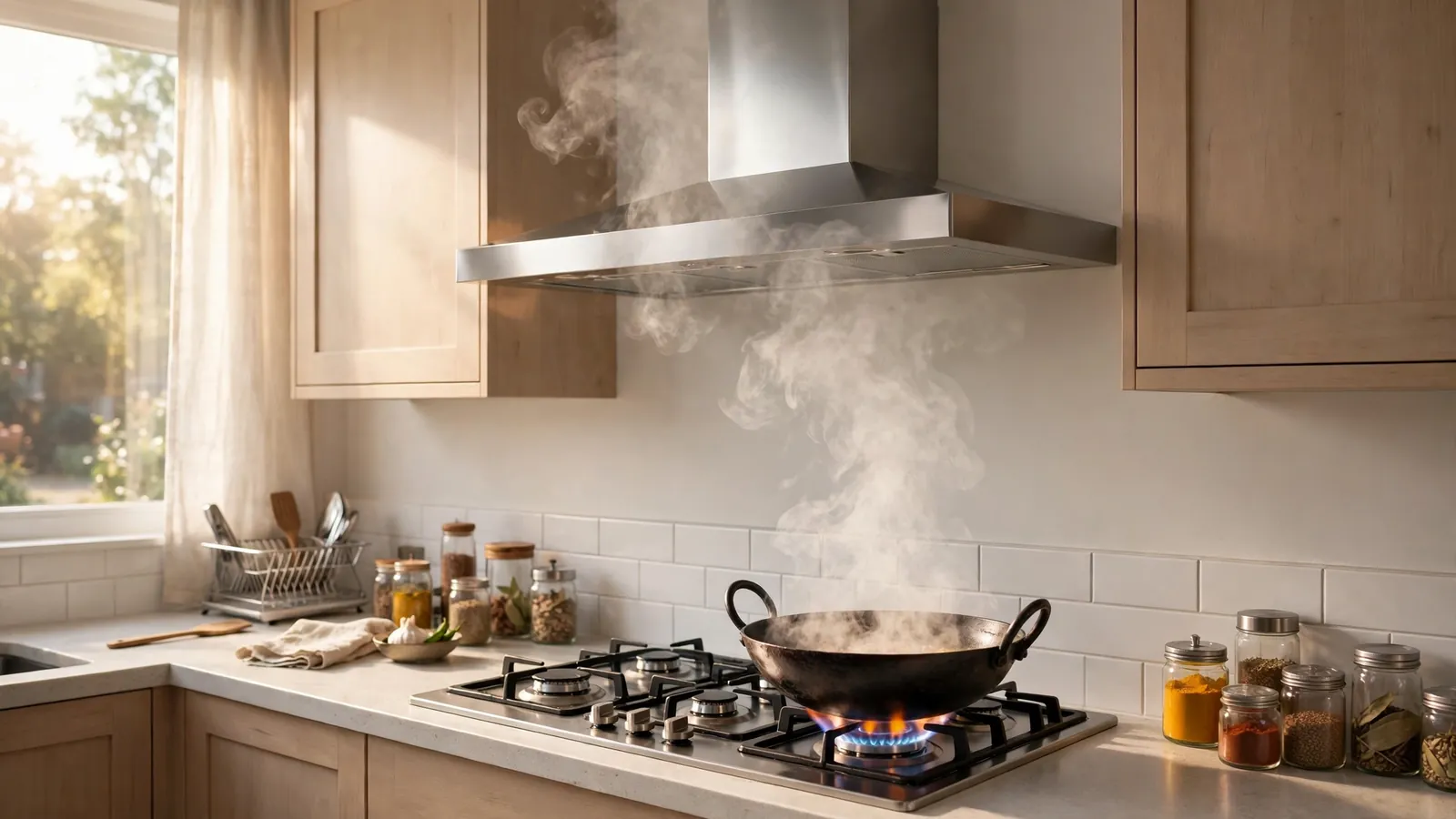
A tadka pops, oil smokes, and within a minute the whole kitchen smells of fried spices — and so does the living room, the curtains and your clothes. That is the test an Indian kitchen sets for a chimney, and it is harder than most showroom brochures admit. A chimney that copes with boiling pasta may not cope with a kadhai of hot oil.
1. Why Indian cooking is the hardest test for a chimney
Most chimneys are designed around light cooking: boiling, steaming, a quick sauté. Indian cooking is different in three ways. The heat is higher — tadka and deep frying throw up far more smoke than a simmering pot. The oil load is heavier — frying and spice roasting put fine oil droplets into the air that coat filters, ducts and cabinets. And the cooking lasts longer — two or three burners at once, often for an hour.
That is why the complaints are so consistent: the chimney "works" in the showroom and fails at home. Smoke escapes because the hood is narrower than the hob; suction feels weak because the duct runs twenty feet with four bends. The filter clogs in a month because it is a fine mesh in a frying-heavy kitchen. None of these is a faulty motor — each is a selection mistake. A chimney removes smoke, oil and smell, not heat.
2. Start with the hob, not the chimney
Every chimney decision follows from the hob — its width, its burners, gas or electric. Choose the chimney first and you will end up fitting the hob to it.
Gas hobs are still the default Indian choice: instant flame control, and they work with the round-bottomed kadhai and tawa Indian cooking is built around. Common widths: 60 cm for 2–3 burners, 75–90 cm for 4 burners, up to 100–110 cm for 5. Count burners honestly: a kadhai, a pressure cooker and a milk pan at once is three burners of smoke.
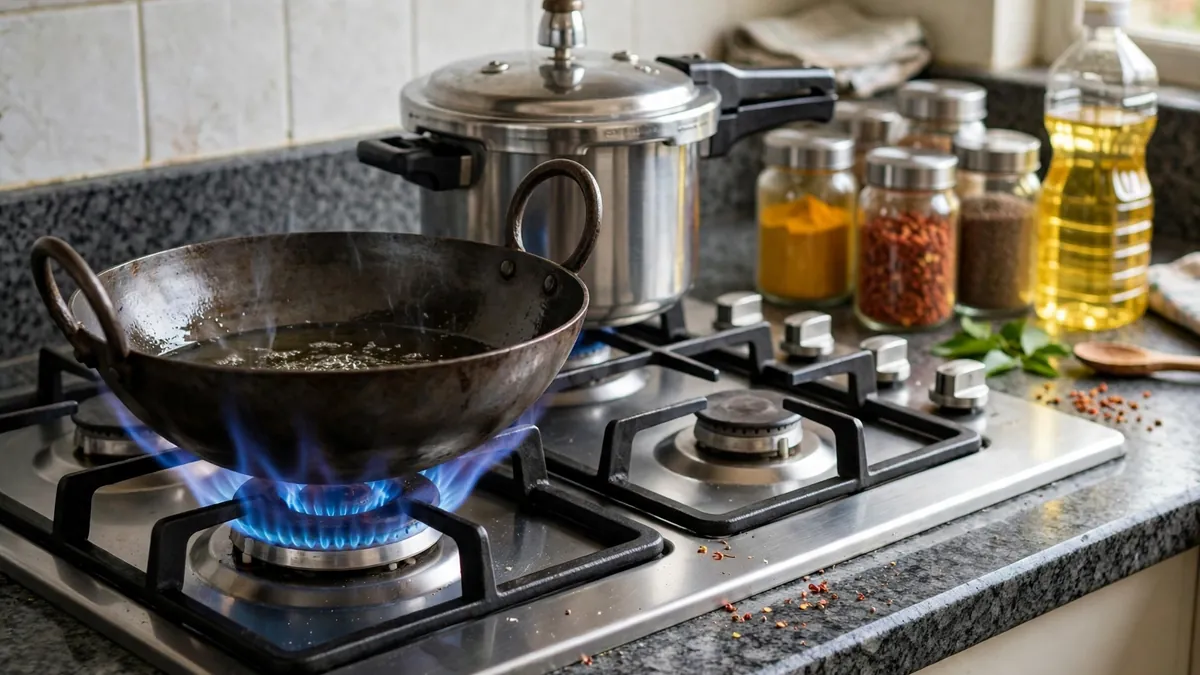
Induction hobs are the quiet alternative. They heat the vessel, not the surface, so the kitchen stays cooler and a spill wipes off flat glass. The trade: induction needs flat-bottomed vessels — a round kadhai will not sit on it — and it draws serious electrical load, so the circuit, MCB rating and earthing must be checked first. Our house wiring guide explains earthing, MCBs and load planning.
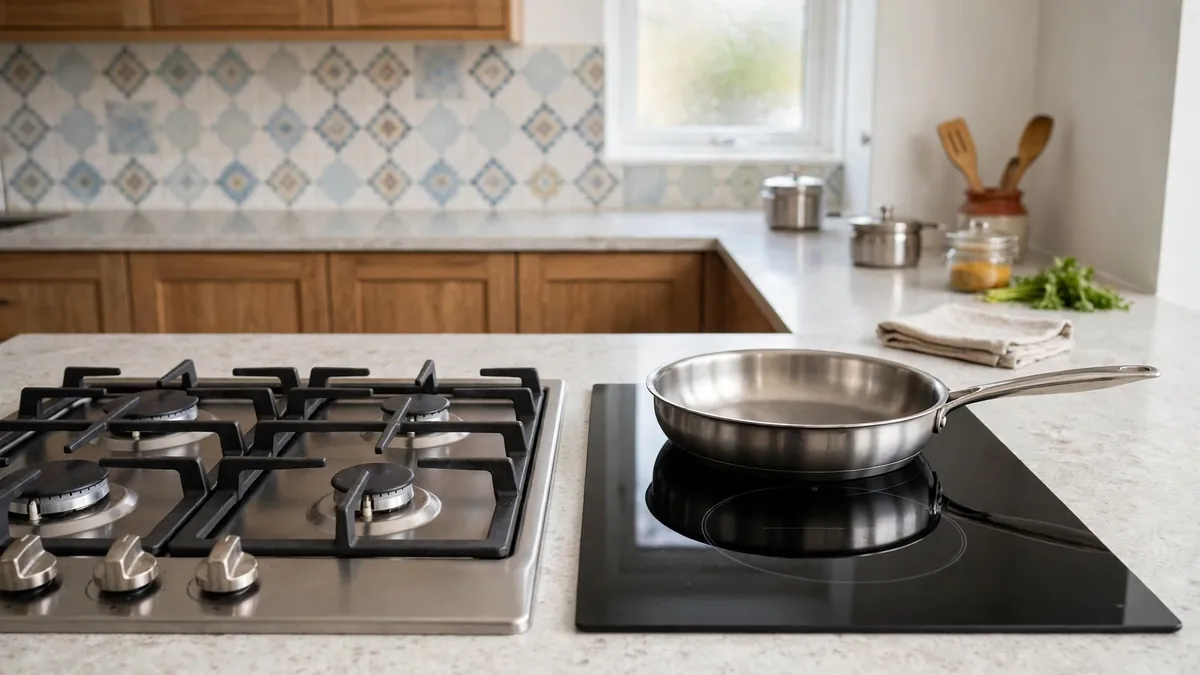
Before you order, measure the worktop cut-out, not just the hob — a wrong cut-out means a new counter or a different hob.
3. Chimney size: 60 cm or 90 cm?
The rule every guide agrees on: the chimney must be at least as wide as the hob — never narrower. Ideally about 15 cm wider, overhanging the outer burners. A 60 cm chimney over a 90 cm hob misses the outer burners entirely, and no suction fixes that.
| Hob width | Burners | Chimney width |
|---|---|---|
| 30–60 cm | 2–3 burners | 60 cm (60–75 cm recommended) |
| 65–80 cm | 3–4 burners | 75 cm (75–90 cm recommended) |
| 82–110 cm | 4–5 burners | 90 cm or wider |
Width is only half the size question — depth matters too. Aim for about 24 inches (61 cm) deep, so the front burners sit under the hood too. A shallow 20-inch hood misses the front burners, where the kadhai usually sits.
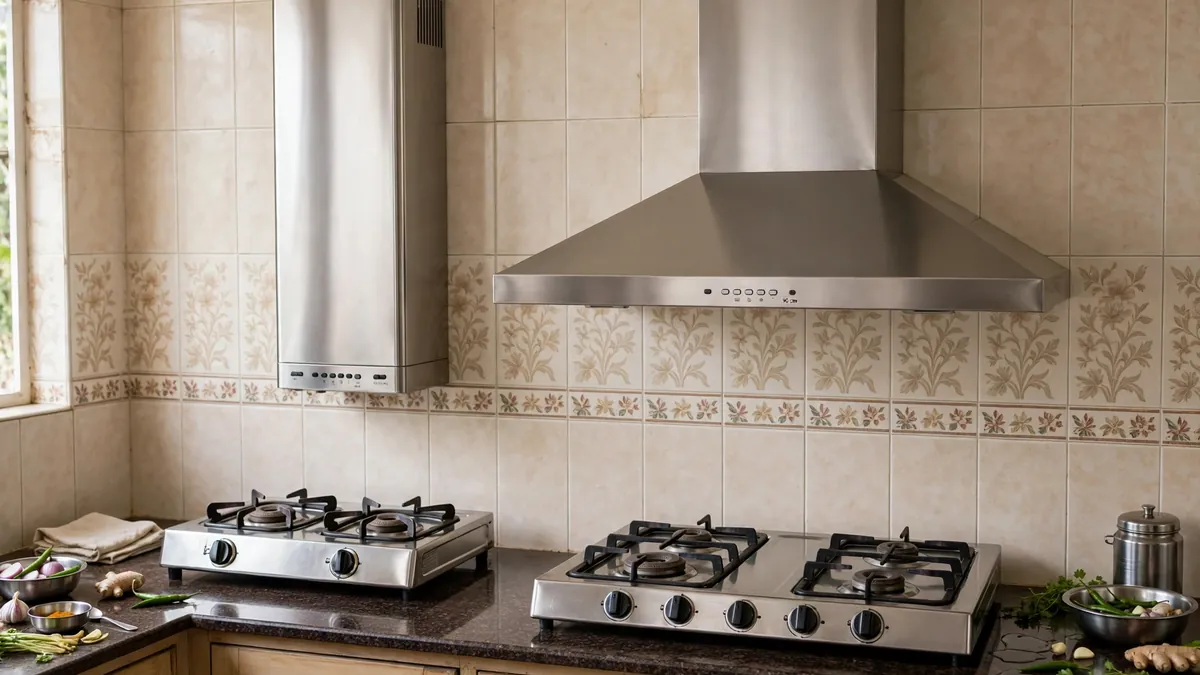
The chimney type follows the layout. A wall-mounted chimney suits the standard kitchen, where the hob sits against a wall. An island chimney hangs from the ceiling over a mid-room hob and needs its own duct route — it costs more and the duct run is longer. An integrated model hides in a wall unit, but catches less — a compromise.
4. Suction power: how much m³/hr does an Indian kitchen need?
Suction is measured in cubic metres per hour (m³/hr) on Indian listings. Some guides use CFM instead — never compare the two directly.
| Cooking style | Suction needed | Typical kitchen |
|---|---|---|
| Light — boiling, steaming | 400–600 m³/hr | Small kitchen, little frying |
| Regular — frying, spices | 700–1,000+ m³/hr | Everyday Indian cooking |
| Heavy — frying, spice roasting | 1,000–1,200 m³/hr | Open or congested kitchen |
| Very heavy — open-plan | 1,200–1,500 m³/hr | Open-plan kitchen |
For most Indian homes, 1,000 m³/hr is the honest starting point — regular frying sits in the 700–1,000+ range, heavy frying pushes it to 1,000–1,200. A 400–600 m³/hr chimney is built for light cooking and will feel weak when you fry. The guides' volume rule (kitchen volume × 10, × 15 for heavy cooking) is a floor, not a target — it ignores frying, so use the table above.
Two things push the number up: a long duct run (add 200–300 m³/hr) and an open-plan kitchen (use the top of the range). Ignore the maximum speed on the box — a chimney rated 1,200 m³/hr at its loudest speed is not that in daily use. Check the noise at the speed you will actually run, because a chimney you switch off does nothing.
5. Ducted or ductless — which is better for Indian cooking?
A ducted chimney vents smoke, oil and smell outside. A ductless chimney pulls air through a carbon filter and blows it back into the kitchen. For Indian cooking, the guides are unanimous: ducted wins.
Ducted: the right choice for Indian cooking
- Best fit: Frying-heavy kitchens, spice roasting, any kitchen with an external wall nearby.
- Trade-off: Needs a duct route outside; plan it before the false ceiling goes in.
- Site check: Confirm the duct route before ordering.
Ductless: only when ducting is impossible
- Best fit: No external wall, rented homes, temporary setups.
- Trade-off: Carbon filters trap smell, not all oil and heat; change them every 3–6 months.
- Site check: Budget for filter changes.
The reason is the oil. A ducted chimney throws the oily air outside; a ductless one catches some of it in a carbon filter and returns the rest to the room. In a frying-heavy kitchen the carbon filter saturates in 3–6 months and then does almost nothing. Ductless also returns the heat to the kitchen. Choose ductless only when a duct is impossible — no external wall, no core-cut permission, or a rented home.
6. Ducting: the part that decides whether the chimney works
The duct is where good chimneys go to fail: if the air must travel a long, bent, narrow pipe, most of the suction is spent fighting the pipe. Plan the route before you order the chimney — ideally before the false ceiling is built.
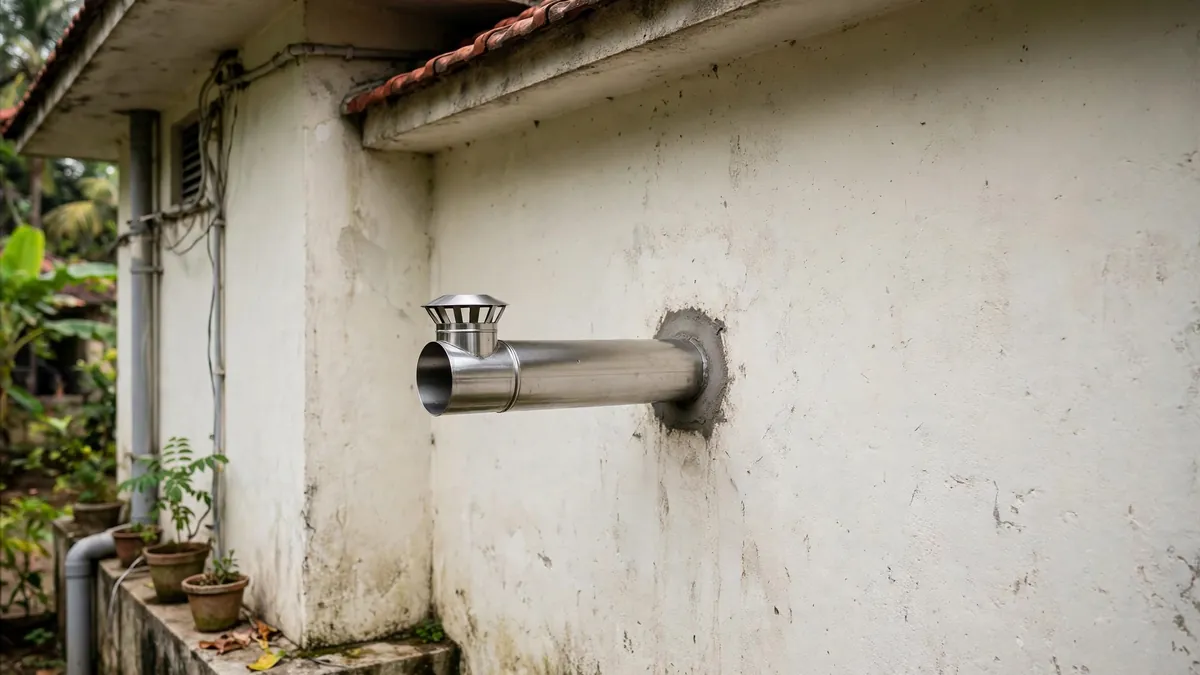
Keep it short and straight. Ideally 10 feet (3 metres) or less, 6–8 feet best. Every extra foot costs suction, and every bend costs more: allow at most 2–3 bends, use wide-radius elbows, avoid sharp 90-degree turns.
Get the diameter right. The minimum is 6 inches (150 mm); 8 inches is better, and high-capacity models may need 10 inches. Match the outlet diameter on the data sheet — never reduce the duct below it.
Use rigid ducting. Rigid stainless steel or aluminium holds its shape and keeps air moving smoothly. Flexible plastic or PVC sags, collects grease in the dips, and can crack or get blocked — and its ribbed inside adds friction. Insist on rigid duct, properly supported, joints sealed, and a vent cap outside.
Check the duct route before ordering: ceiling height, wall position, duct length and bends, outlet diameter. A duct over 10 feet or with more than 2–3 bends needs a higher rating — add 200–300 m³/hr.
7. Filters: baffle, mesh or carbon — and auto-clean
The filter is the part you will touch most, so choose it for your cooking, not the showroom. Three types are sold, and they behave very differently in an oily kitchen.
Baffle filters are the pick for Indian cooking. Curved metal channels force the air to change direction; oil droplets hit the metal and run into a tray. They handle grease well, clean easily in hot soapy water, and last for years.
Mesh filters are the wrong choice for frying. Fine aluminium mesh catches oil in tiny holes that clog fast in oily cooking. A clogged mesh filter chokes the airflow, the suction drops, and the kitchen fills with smoke. Mesh suits light cooking; in an Indian kitchen it is a chore most households skip.

Carbon filters belong to ductless chimneys. They absorb smell before the air is blown back into the room, and need replacing every 3–6 months. They do not catch oil the way a baffle does. Auto-clean chimneys heat the filter area so oil drips into a tray instead of baking on — worth it if you fry daily, but not a substitute for washing the filter.
8. Installation height, noise and the features worth paying for
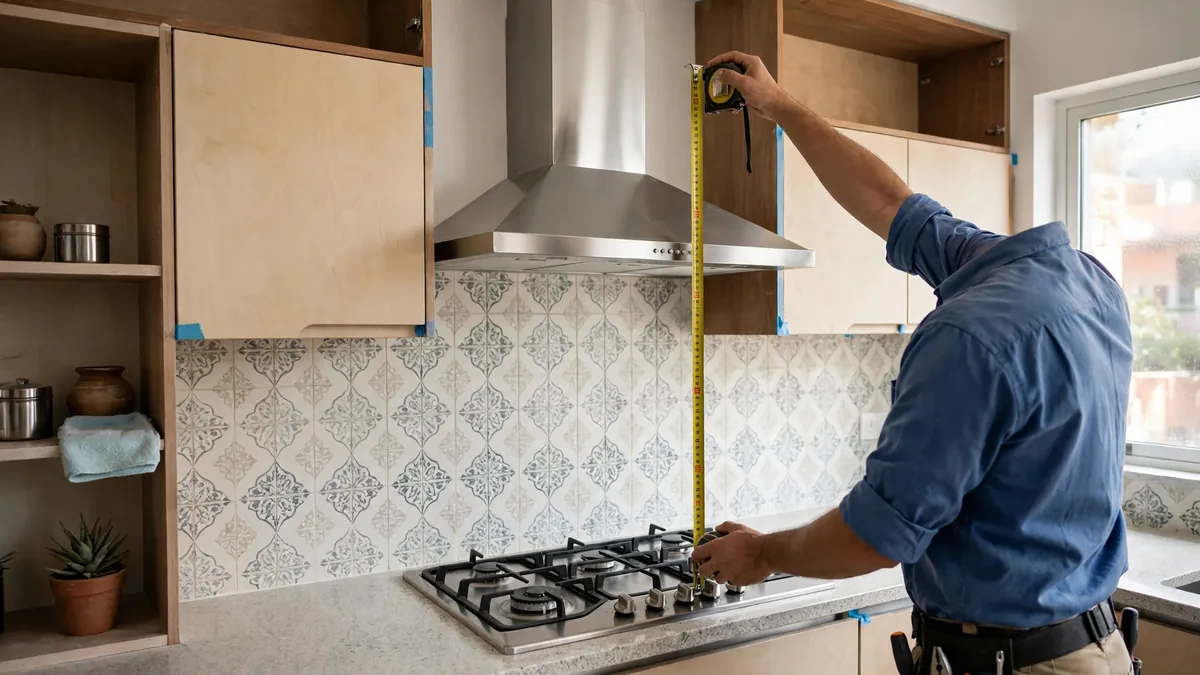
Height is a range, not a guess. For a wall-mounted chimney over a gas hob, the guides put it at 24–30 inches (60–75 cm) above the hob. Over an open gas flame, stay at 26–30 inches — too low is a fire risk and cuts the capture area. Too high and the suction falls off as the smoke spreads. Measure from the hob surface, and follow the model's manual.
Noise decides whether the chimney gets used. A chimney rated at 58 decibels sounds fine on paper and loud in a small kitchen at full speed. Check the noise at the speed you will actually cook at, and run it in the showroom at that speed. A quiet chimney on medium beats a loud one on high that you leave off.
Features worth paying for: a baffle filter and auto-clean if you fry daily; a motion sensor or touch control for oily hands; a heat sensor that raises the speed when the hob is hot; and a timer that keeps the fan running a few minutes after cooking. Worth skipping: display lighting, a fingerprint-prone finish, and a remote you will lose. Spend the money on width, suction and ducting first. The chimney also needs a dedicated electrical point with a switch, where the cable reaches without crossing the hob. Our Vastu kitchen guide covers kitchen placement.
9. Mistakes homeowners make — and your pre-order checklist
Buying the chimney before the hob. The hob decides the size. Choosing on the maximum suction number. Buy for the suction you will actually use, not the top speed. Ignoring the duct. A long, bent, narrow duct wastes more suction than any motor can add. Picking a mesh filter for a frying kitchen. It will clog. Going ductless when a duct is possible. Recirculating air is a compromise.
Keep this list with the order: 1. Hob first — width, burners, gas or induction, cut-out measured. 2. Chimney at least as wide as the hob, 15 cm wider ideally, 24 inches deep. 3. Suction matched to cooking — 1,000 m³/hr to start, more for heavy frying, open plans, long ducts. 4. Ducted, short straight rigid duct, 6 inches minimum, matching the outlet. 5. Baffle filter, auto-clean if you fry daily. 6. Height 24–30 inches above the hob, 26–30 over gas flame. 7. Prices in writing — illustrative 2026: chimneys Rs 8,000–25,000, hobs Rs 6,000–20,000.
A chimney is a small share of what a kitchen costs and the whole of what keeps the house smelling clean. Spend the hour on the duct route and the filter choice, buy the width and suction your cooking needs. If you are planning a kitchen, talk to RTPL Constructions & Engineering before you order — and check the kitchen against our new house handover checklist before you take the keys.
Last reviewed: 15 November 2026. Figures from guides found by web search on 14 Nov 2026; prices illustrative — confirm locally.