Ask ten homeowners which is cheaper — turnkey or labour contract — and you will get ten confident answers, most of them wrong. The labour contract always looks cheaper on the first page of the quotation. It is the last page that decides: the wastage, the delays, the price rises, and the hours of your own time that nobody put in the quote. This guide compares both models on the same house, with the same specification, so the answer is about your situation — not a headline rate.
The three models, plainly explained
Indian homeowners actually choose between three arrangements.
Turnkey (lump-sum) contract. One contractor supplies everything — material, labour and supervision — at an agreed rate per sq ft, and hands you a finished house. You agree the scope and specification in writing, pay in stages linked to progress, and the contractor carries the procurement, coordination and wastage. Our guide to turnkey home construction in India explains what "turnkey" covers and where it falls short.
Labour-rate contract. You buy all the material yourself — every bag of cement, every steel bar, every tile. The contractor supplies only labour and supervision, at a rate per sq ft, and manages the workers. You control material quality and brands, but you also carry the buying, the transport, the storage, the wastage and the scheduling.
Direct (material + labour separately). You manage everything yourself, hiring masons, carpenters, plumbers and electricians trade by trade, often on daily wages. It is the lowest headline cost and by far the heaviest load on your time.
The difference between the three is not mainly money. It is how much of your own time and attention the job will need. A relative's recommendation is not a comparison; a written scope against a written scope is.
What each model actually costs
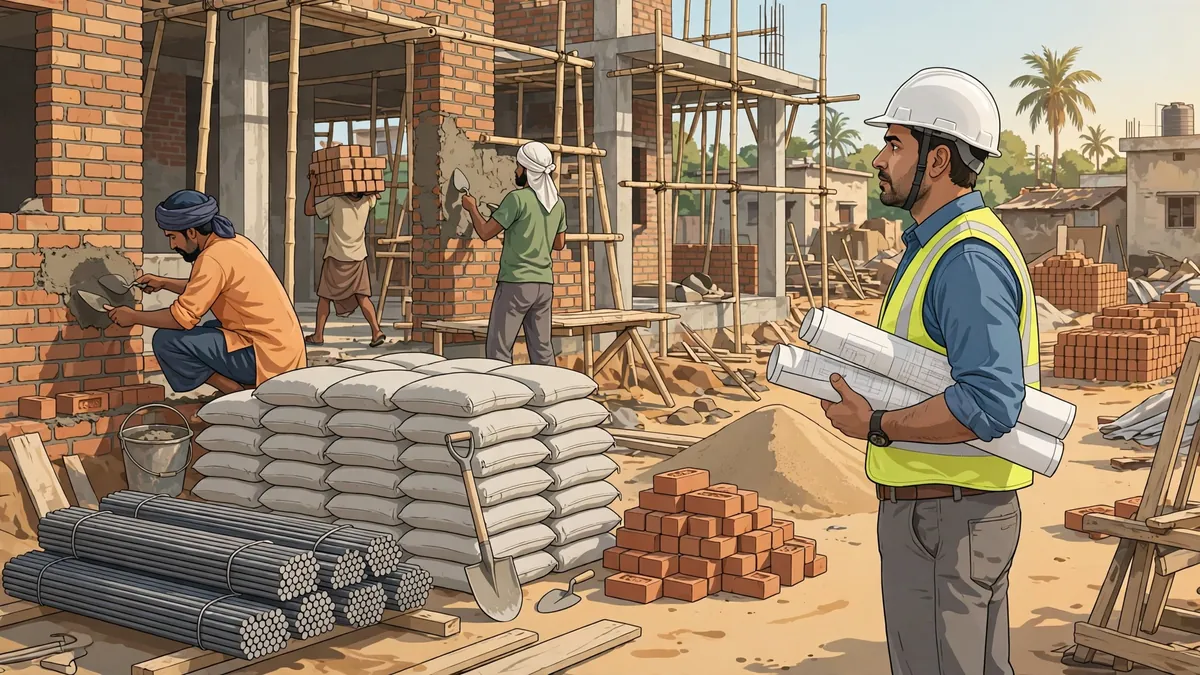
Start with the honest ranges. Published 2026 guides put turnkey rates roughly between ₹2,300 and ₹4,000 per sq ft, lower in tier-2 cities (Jaipur around ₹1,500–₹2,200, Lucknow around ₹1,600–₹2,200, Bangalore around ₹2,400–₹4,500 and above — all illustrative, Nov 2026). Labour-only rates are quoted roughly between ₹220 and ₹550 per sq ft, with ₹350–₹550 the most commonly cited band. Labour typically runs 22–35% of the total project cost; materials roughly 60–65%, and the contractor's margin roughly 5–10%.
The turnkey headline rate is usually 10–15% above the others — but that comparison is meaningless, because the labour figure excludes all materials. The only fair comparison is the total cost of the same finished house:
| Cost item | Turnkey | Labour-rate contract | Direct (owner-managed) |
|---|---|---|---|
| Headline rate | ₹2,050 / sq ft | ₹450 / sq ft (labour only) | Daily wages |
| Labour component | Included | ₹5,40,000 | ₹4,80,000 |
| Material you buy | Nil | ₹15,60,000 | ₹15,60,000 |
| Expected wastage | Contractor's problem | 3–5% | 5–8% |
| Realistic total | ₹24,60,000 | ₹21,70,000 | ₹21,30,000 |
Two things stand out. First, the gap between turnkey and the labour contract is about ₹2.9 lakh on a ₹24.6 lakh house — roughly 12%, not the 30–40% many owners expect. Second, the gap between the labour contract and going fully direct is only about ₹40,000 — far smaller, for a great deal more work. The labour contract is the middle ground that delivers most of the saving; going fully direct mostly buys you a second job. Before you trust any of these figures for your own house, read our house construction cost guide for 2026, which breaks the same per-sq-ft ranges down by city and quality level.

Where the labour contract's saving leaks away
A labour contract saves money only if the material side of the job is run well. There are five leaks.
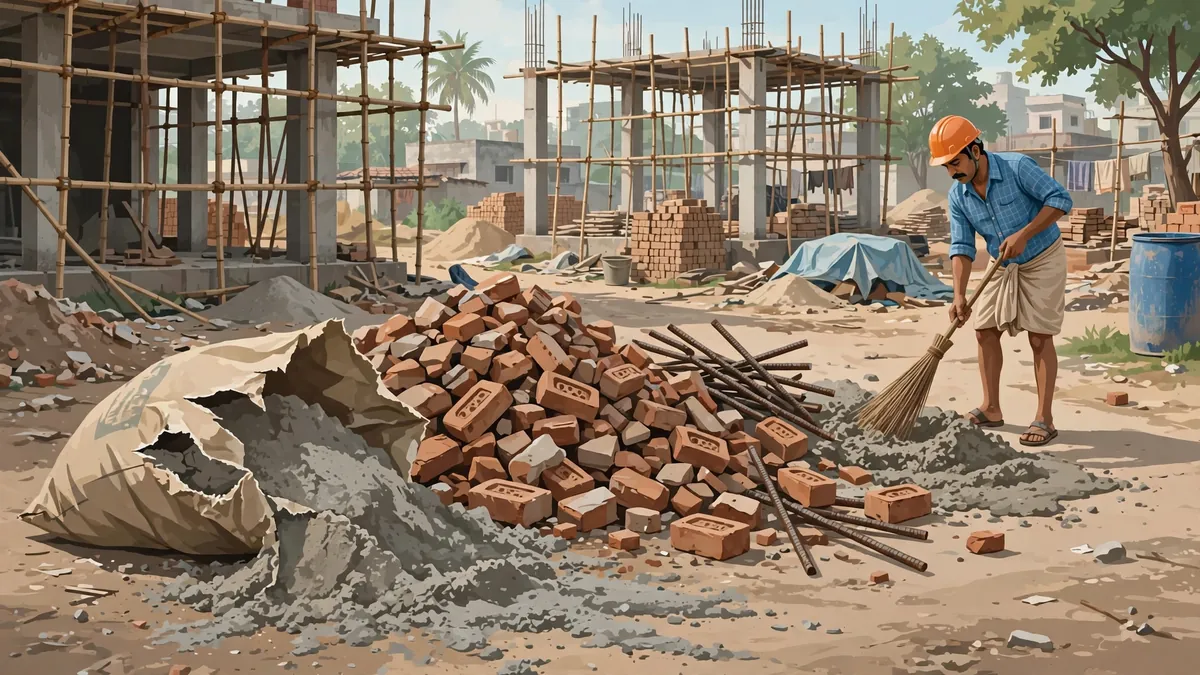
Wastage. Under a labour contract the contractor is not paying for materials, so there is no incentive to conserve steel or cement. One guide's worked example allows 3–5% wastage under a labour contract and 5–8% when the owner manages everything directly. Even at the modest end, 5% of a ₹15 lakh material bill is ₹75,000 — a quarter of the saving you expected.
Theft and pilferage. Cement bags, steel bars and fittings walk off unsupervised sites. Under turnkey, that loss is the contractor's; under a labour contract, it is yours.
Retail vs wholesale. A contractor buying for several sites gets wholesale rates and delivery included. You, buying for one house at retail, pay more per bag and per bar, and you pay transport on every small load.
Price escalation. A build takes 8–13 months, and steel and cement prices move in that time. Under a labour contract, every rise is yours. One published example put the escalation over 12 months at ₹1.8 lakh; under a locked turnkey BOQ, the builder absorbs it.
Delays and rework. Materials arriving late stall the masons you are paying by the day. Poor supervision means mistakes are found late, and rework is paid for twice — once to build wrong, once to build right. None of this appears in the labour rate.
The turnkey premium — and its hidden exclusions
Turnkey is not a free lunch either. You pay for the convenience, and the premium is real: the contractor's margin on materials, the supervision cost, and the risk the contractor prices in for escalation and wastage.
The bigger turnkey trap is exclusions. One published 2026 breakdown warns to add 12–18% to a turnkey quote for typical exclusions before comparing it with anything else. Approvals, utility connections, borewell, compound wall and interiors are commonly excluded — and each one is a real bill that arrives later. Our guide to hidden costs in home construction lists twelve expenses homeowners forget to budget, and most of them sit in exactly this gap. Read the exclusions list before the rate card; that is where turnkey deals are won or lost.
There is also an area-basis trap. A contractor quoting ₹1,900 on built-up area may be cheaper than one quoting ₹1,750 on super built-up area, because the two figures are measured on different areas. Always compare quotes on the same area definition, the same drawings and the same specification — otherwise the cheaper number is an illusion. The other turnkey weakness is changes: mid-project changes are hard to price fairly without item rates in the contract, so a loose quote makes every change an argument. Get the item rates in writing before work starts, not after the first change.

The fair comparison: build one sheet
Here is the method that actually answers the question for your house. Take one sheet of paper — or one spreadsheet — and fill in both columns for the same house, the same drawings, the same specification and the same area basis.
Column A — turnkey. The turnkey quote, plus every exclusion priced separately (approvals, connections, borewell, compound wall, interiors), plus GST as applicable — ask your CA about the works-contract treatment rather than assuming it.
Column B — labour contract. The labour quote, plus your material estimate at retail prices, plus 5% wastage, plus transport, plus your supervision time valued honestly, plus an escalation allowance for the build period. Add a site supervisor or engineer if you are hiring one.
Then compare the two totals, not the headline rates. And compare the specifications line by line: check that both quotes use the same material brands and grades — the same cement, the same TMT grade such as Fe 500D, the same concrete grade, the same tiles allowance. A cheaper quote often means cheaper materials, not a cheaper house. Our guide to reading a BOQ like an engineer shows how to check a quotation line by line, and it works for both models. One more check: the same-house test only works if both contractors quoted on the same drawings. If one quoted from a sketch and the other from approved drawings, you are comparing two different houses.
Which model fits which owner
Be honest about your time, not your budget — that is the decision rule one 2026 guide states most plainly. If you cannot visit the site three or four times a week, take the turnkey contract and spend your effort on writing a proper specification instead. The 10–15% you would have saved will disappear into wastage and delays anyway.
If you can genuinely be present, a labour-rate contract gives you the best balance: full control over material quality, with someone else managing the workers. A useful self-test, published by a Lucknow builder, is to choose a labour contract only if you have prior civil construction experience, a vehicle for material runs, four to six free hours every day to sit on site, and trusted wholesale material connections. Tick all four and the saving is real.
The owner profiles line up neatly. Choose turnkey if you are a working professional, an NRI, a doctor or a business owner who values fixed-price certainty and expects a formal written warranty. Choose a labour contract if you live near the site, know the material market, can supervise most days, and enjoy the control. Choose direct management only if you have done it before — for a first house, it is the most expensive lesson in construction.

Whichever model you choose, the contract decides what you actually get — not the word "turnkey" or "labour" on the first page. A written scope, a written material specification and stage-wise payments linked to verified progress are what protect you. If a contractor will not put it in writing, that is your answer.
What the contract must say, either way
The model matters less than the document. Both contracts need the same minimums.
First, the scope of work, with the drawings and specifications the house will be built against. Second, the material specification — brand and grade of cement, TMT steel grade, concrete grade, blocks or bricks, tiles allowance, sanitaryware, wires and switches. Third, the inclusions and exclusions list, with every exclusion named. Fourth, stage-wise payments linked to verified milestones: pay after the foundation, after each slab, after plastering — not large amounts in advance. Fifth, a written change-order process: any change priced and signed before work starts. Sixth, a project schedule with milestone dates. Seventh, written warranty and defect-liability terms.
Under a turnkey contract, also insist on item rates for likely changes, a named supervisor, and inspection records. Under a labour contract, also agree who supplies consumables, who stores and issues materials, and what happens when material delivery is late — because a stalled mason still gets paid. Our guides to construction contract payment schedules and choosing a contractor cover the clauses and verification checks in detail.

Final verdict: which one saves more?
For most working homeowners building their first house, turnkey saves more — not on the quotation, but on the finished house. The labour contract's 10–15% paper saving shrinks to about ₹2.9 lakh on a ₹24.6 lakh house in the worked example, and wastage, escalation, retail material prices and delays can erase the rest before the roof slab is cast. What turnkey buys is a single point of accountability, a locked price, and a contractor who pays for his own mistakes.
For the owner who can be on site most days, knows the material market and enjoys the control, the labour contract is genuinely cheaper. The saving is real, but it is a wage: you earn it with your time and attention, day after day, for the length of the build.
So the question is not which model is cheaper. It is which model is cheaper for you, with your time, your experience and your distance from the site. Build the one-sheet comparison, value your own time honestly, and let the totals decide. If you would like a site engineer to review your two quotations side by side before you sign, talk to RTPL — an hour of review before signing beats a dispute halfway through the build.