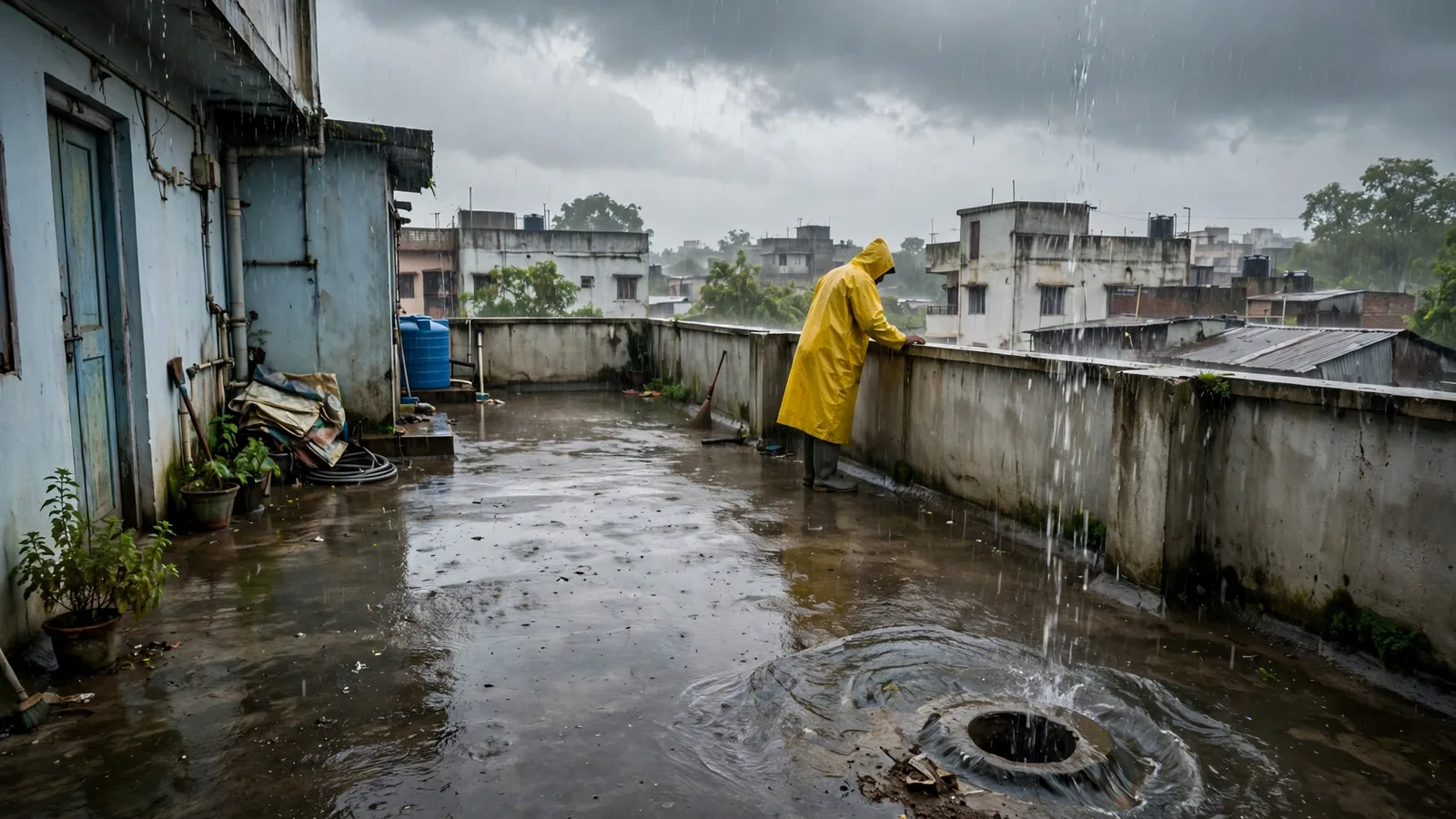
Most monsoon damage in Indian homes is caused by the small job not done before the rain. A blocked drain outlet, an unsealed terrace crack, an outdoor meter box whose cover stopped closing. When the first heavy downpour arrives, all three fail at once — and the repair bill is many times the maintenance cost. This checklist walks your home zone by zone.
1. When to do it: at least a month before the first heavy rain
The timing rule is the one thing every guide agrees on: do monsoon maintenance before the season, at least a month before the first heavy rain. In most of India that means finishing the work by May, before the southwest monsoon arrives in June. Waterproofing chemicals, crack fillers and sealants need a dry surface to bond. Apply them on a wet terrace in July and they peel off with the first downpour; do the same job on a dry terrace in April and it holds for the season.
Work done during the monsoon also costs more — the mason is busy, the material is in demand, and the job has to be squeezed between dry spells. If the rains have already started, the cleaning, sealing and electrical checks in this article can still be done between showers.
This checklist covers routine maintenance. A sagging slab, a beam with exposed rusted steel, or a wall cracked through its full thickness needs a qualified structural engineer — those are not maintenance jobs.
2. Roof and terrace: priority one
Start at the top, because that is where the water starts. Walk the whole terrace in daylight: cracks in the concrete, broken or loose tiles, loose cement or plaster, moss in damp corners. A hairline crack on a dry terrace looks harmless, but in the monsoon it becomes a channel to the slab below and the ceiling underneath. Seal every crack before the rains, not after the first leak appears on the ceiling.
Next, check the terrace slope. A terrace that holds water after a light rain has a slope problem, and no coating fixes it — water should run to the drain outlets, not sit in a puddle. If you see ponding, get the slope corrected with a proper screed before the season. Also check the parapet wall for cracks at its top.

If the terrace was waterproofed before, check the coating is still continuous — look for peeling, blistering or bare patches, especially around the drain outlets and the parapet junction. Re-coat the failed patches on a dry day, with full curing time before the first rain. For the full method, read our terrace waterproofing guide, and for summer heat, see cool roof options for Indian homes.
3. Drains, gutters and downspouts: the number-one cause of waterlogging
Ask any engineer what causes most monsoon waterlogging in Indian homes: blocked drains. Not a weak roof, not a bad wall — a drain outlet choked with leaves, plastic and silt. A terrace drain that cannot drain turns the terrace into a pond, and that pond finds every crack and weak joint. Clear every drain outlet, gutter, downspout and floor drain in the house.
Lift the drain covers and pull out the leaves, plastic and silt by hand — a rod or a jet of water pushes the blockage deeper. Run water through each outlet: if it drains slowly, the pipe below is partly blocked and needs clearing now. Check the downspouts and extend them with PVC pipe if they discharge against the wall or the foundation — water falling next to the plinth seeps into the foundation and the ground-floor walls. Check balcony and bathroom floor drains too.

Then make it a habit. During the monsoon, clean the gutters, downspouts and floor drains every week — one storm can drop enough leaves to block a drain that was clear on Monday. A ten-minute weekly clean is the cheapest insurance in this article.
4. Walls, windows and doors: where the rain gets in sideways
Rain does not only fall on the roof. Wind-driven rain hits the walls and gets in through the gaps nobody looks at. Walk around the outside and inspect the exterior walls for cracks, especially near doors, windows and corners. Fill hairline cracks with crack filler or cement-sand render with a waterproofing admixture; wider cracks need a mason first.
Then check the windows and doors. Run a finger along the gap between the frame and the wall — if you can feel a draught, rain can get in. Seal those gaps with a weatherproof sealant, and check the window rubber beading: hardened or shrunken beading leaves a gap no outside sealant will fix.

Inside, a damp patch that returns every monsoon in the same place is telling you where the water enters — follow it upward and outward, because the entry point is usually above or beside the patch, not behind it. A leaking bathroom is the most common source of damp in an Indian home — see our bathroom waterproofing mistakes guide.
5. Electrical safety: the section not to skip
Moisture and electricity are the most dangerous combination in a monsoon home. Wet walls, wet hands and a frayed wire are all it takes, and short circuits are the top monsoon electrical risk. Do these checks before the season — and do not do live electrical work yourself; call a licensed electrician.
Start outside. Every outdoor fitting — the meter box, the outdoor switchboard, the gate light, the garden socket — must have a weatherproof cover that actually closes; a cover that hangs open is no cover at all. Outdoor wiring should run inside waterproof conduit, not clipped bare along the wall. Replace any wire whose insulation is cracked, frayed or chewed.

Inside, confirm that the house has an ELCB or RCCB — the device that trips when current leaks through water or a person — and that it works. Press its test button: if it does not trip, call an electrician before the rains, because a dead RCCB is the same as no RCCB. The standard sensitivity for bathroom and geyser circuits is 30 mA, and earthing should follow IS 3043:2018. Two habits for the season: never handle a plug or a switch with wet hands, and never touch an outdoor switch or a pump during a thunderstorm. For the full picture, read our house wiring guide.
6. Plumbing, water storage and standing water
Exposed pipes take a beating in the monsoon. Walk the outside of the house and inspect every exposed pipe for corrosion, cracks and dripping joints — a small leak in May becomes a steady one in July. Check the water tank on the terrace: the lid must sit properly, the overflow pipe must be clear and directed away from the wall, and the inlet valve must shut off.

Then look down. Standing water anywhere around the house is a problem twice over: it seeps into the plinth and the ground-floor walls, and it breeds mosquitoes. Clear every spot where water collects — the saucer under a plant pot, the depression next to the boundary wall, the tray under the air-conditioner outdoor unit. If the house has a rainwater harvesting pit, clean its filter before the season — our rainwater harvesting guide covers the system and its maintenance. For the pipes inside the walls, see our plumbing layout guide.
7. The emergency kit: torches, lights and surge protection
Power cuts are part of the monsoon in most Indian towns, and the night of a heavy storm is the worst time to discover that the torch has dead batteries. Put the kit together before the season and keep it in one known place: a torch with fresh batteries, a rechargeable emergency light, candles and matches, a charged power bank, and a small first-aid box — keep the torch by the bed.

Protect the electronics too. A surge protector on the television, the router and the computer costs little and saves the devices lightning kills most often. In a severe thunderstorm, unplug the non-essentials — nothing protects a plugged-in device from a direct strike as surely as being unplugged.
8. What it costs: an illustrative budget
Most of this checklist costs time, not money — the drain cleaning, the inspection and the sealing checks are free. Here are the guide figures from our research, labelled clearly as illustrative: they come from one Indian guide, were not verified against a live supplier, and vary by city, supplier and season. Get a local quote before you budget on them.
| Item | Illustrative range | What it covers |
|---|---|---|
| Waterproof paint / rust treatment | ₹500–₹1,200 per sq ft | Terrace and exterior wall coating |
| Waterproofing slurry | ₹80–₹120 per litre | Crack and joint sealing slurry |
| Waterproofing admixture | ~₹150 per bag | Mixed into cement-sand render for crack repair |
| Replacement roof tiles | ₹30–₹70 each | Broken or loose tiles replaced |
| IP65-rated waterproof fittings | ₹250–₹400 each | Outdoor lights and sockets with weatherproof covers |
| 30 mA RCD / RCCB | ~₹1,200 | Earth-leakage protection device |
| PVC pipe (downspout extension) | ₹150 per metre | Extending downspouts away from the foundation |
Read the table this way: the materials for a typical independent house usually run into a few thousand rupees, and a day of a mason's and an electrician's labour is the bigger part of the bill — far less than the ceiling, wall or distribution board the maintenance protects.
9. During the monsoon: the weekly habits
Preparation is half the job; the other half is the small weekly routine. Once a week, clean the gutters, downspouts and floor drains. After every heavy rain, walk the terrace and look for ponding: water that stands for more than an hour after the rain stops means a drain is blocked or a slope has failed. Inside, check the usual damp spots and catch a new damp patch in its first week, when it is a small job.
Keep the windows closed on the windward side during a storm, and open them again when the rain stops so the rooms dry out — a house aired between showers stays dry. And keep the emergency kit where it belongs: it only works if it is in the house when the lights go out.
Your monsoon maintenance checklist
- Timing: finish everything at least a month before the first heavy rain.
- Roof and terrace: seal cracks, replace broken tiles, check the slope drains to the outlets.
- Drains and gutters: clear every outlet, gutter, downspout and floor drain by hand; clean weekly through the season.
- Walls, windows and doors: seal cracks near openings, seal frame gaps, check beading and thresholds.
- Electricals: weatherproof covers outdoors, wiring in conduit, frayed wires replaced, RCCB test button checked — live work by a licensed electrician only.
- Plumbing and storage: exposed pipes checked, tank lid and overflow checked, standing water cleared.
- Emergency kit: torch, rechargeable light, candles, power bank, first-aid box in one known place.
- Weekly during the rains: clean drains, check for ponding, inspect the usual damp spots, air the rooms.
A monsoon-ready house is not a house that was built differently. It is an ordinary house whose drains were cleared, whose cracks were sealed, and whose electricals were checked before the rain arrived. Do the work a month early, keep the weekly routine through the season, and the first heavy downpour becomes something to watch from the balcony instead of something to repair afterwards. Taking over a new home? Run the same eyes over it with our new house handover checklist — and if you are planning a house build, talk to RTPL Constructions about getting the slopes, drains and waterproofing right from the start.
